Reusable Bag Printing Methods Compared: Screen, Transfer, Sublimation and Embroidery
Two orders of the same reusable bag, the same artwork, can come back looking and lasting completely differently depending on how the design was applied. The decoration method decides your color range, how the print survives washing and abrasion, the smallest quantity you can order economically, and which bag fabrics are even on the table. Choosing it before you finalize artwork saves the most common reorder, the one where a logo looked fine on approval and cracked after a month of grocery runs.
Here is how the four methods you will actually be quoted, screen printing, heat transfer, dye sublimation and embroidery, compare on the specs that matter, and how to pick between them.
Screen printing: the volume workhorse
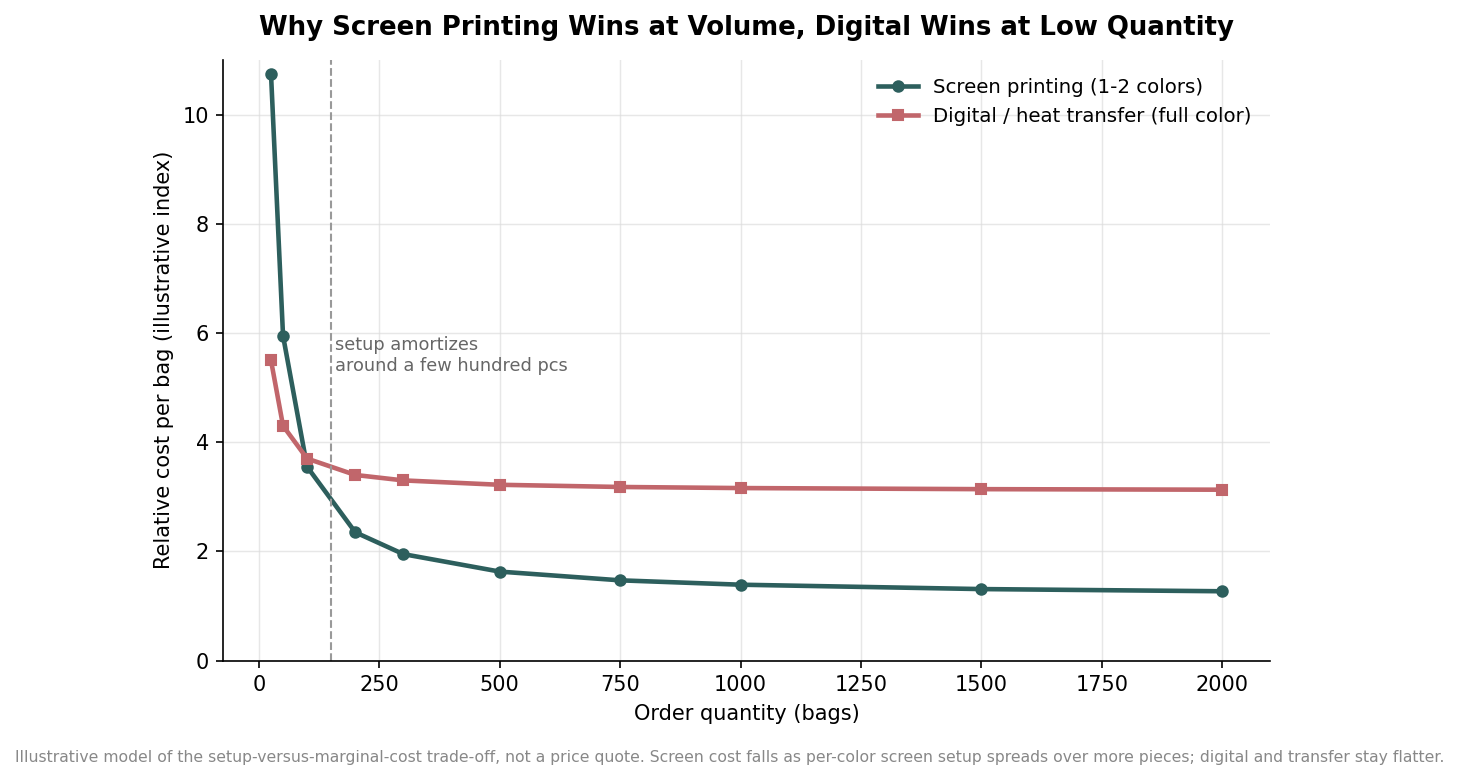
Screen printing pushes ink through a stencil, one screen per color, and it remains the default for cotton, canvas and non-woven polypropylene totes. Its economics are the whole story. Each color needs its own screen and setup, so a one or two color logo is where it shines and a photographic, many-color image is where it stops making sense; most shops steer you toward one to four spot colors. Because the setup cost is fixed, the per-bag price falls steadily as the run grows, which is why screen printing is almost always the cheapest route once you are into the hundreds or thousands of units. The finish is durable and holds up to repeated use, and it lays down cleanly on the flat woven and non-woven surfaces that make up most promotional bags.
The first chart shows the cost behavior that drives this decision: screen printing carries a high fixed setup that spreads thinner over every additional bag, while digital and transfer methods start cheaper but stay flatter per piece.
Heat transfer: small runs and full color
Heat transfer applies a pre-printed film to the bag with heat and pressure, and it inverts screen printing’s strengths. There is little or no per-color setup, so full-color and photographic artwork costs the same as a simple mark, and small quantities are economical in a way screen printing never is. That makes it the practical choice for short runs, sample batches, or designs with many colors. The trade-offs are real: the transferred film can leave the fabric feeling stiffer where the design sits, and its abrasion and wash durability generally sits below screen printing or embroidery over a long service life. It performs best on synthetic and non-woven surfaces and is a weaker fit on heavily textured naturals like jute.
Dye sublimation: edge-to-edge on the right fabric
Dye sublimation turns solid ink into gas that bonds into the fibers themselves, so the color becomes part of the fabric rather than a layer on top. That gives it the best durability of the group, no cracking or peeling because there is nothing sitting on the surface, along with unlimited colors and true edge-to-edge, full-coverage printing. The catch is a hard material requirement: sublimation only works on polyester-based, light-colored surfaces, which in the reusable-bag world means RPET and polyester totes, not cotton, jute or standard woven polypropylene. If you want an all-over printed pattern and you are willing to build the bag in polyester or recycled PET to get it, this is the method; otherwise it is off the table.
Embroidery: the premium, tactile finish
Embroidery stitches the design in thread rather than printing it, and it reads as the most premium and durable option, which is why it dominates on heavier cotton, canvas and jute bags meant to look like keepsakes rather than giveaways. Its cost structure is unusual: pricing is driven by stitch count and a one-time digitizing setup rather than by the number of thread colors, so a multicolor mark does not cost more the way it would in screen printing. It is effective across run sizes, holds up for years, and adds a textured, higher-value feel. The limits are practical: fine detail and small text can get lost in stitching, large solid-fill designs get expensive as stitch counts climb, and it is overkill for a simple disposable-tier bag.
Matching the method to the bag
Because each method favors different fabrics, the decision often gets made for you once the bag material is set. The compatibility matrix below maps the four methods against the common reusable-bag substrates, so you can see, for example, why an all-over print pushes you toward polyester, or why a rustic jute tote points to screen printing or embroidery rather than transfer.
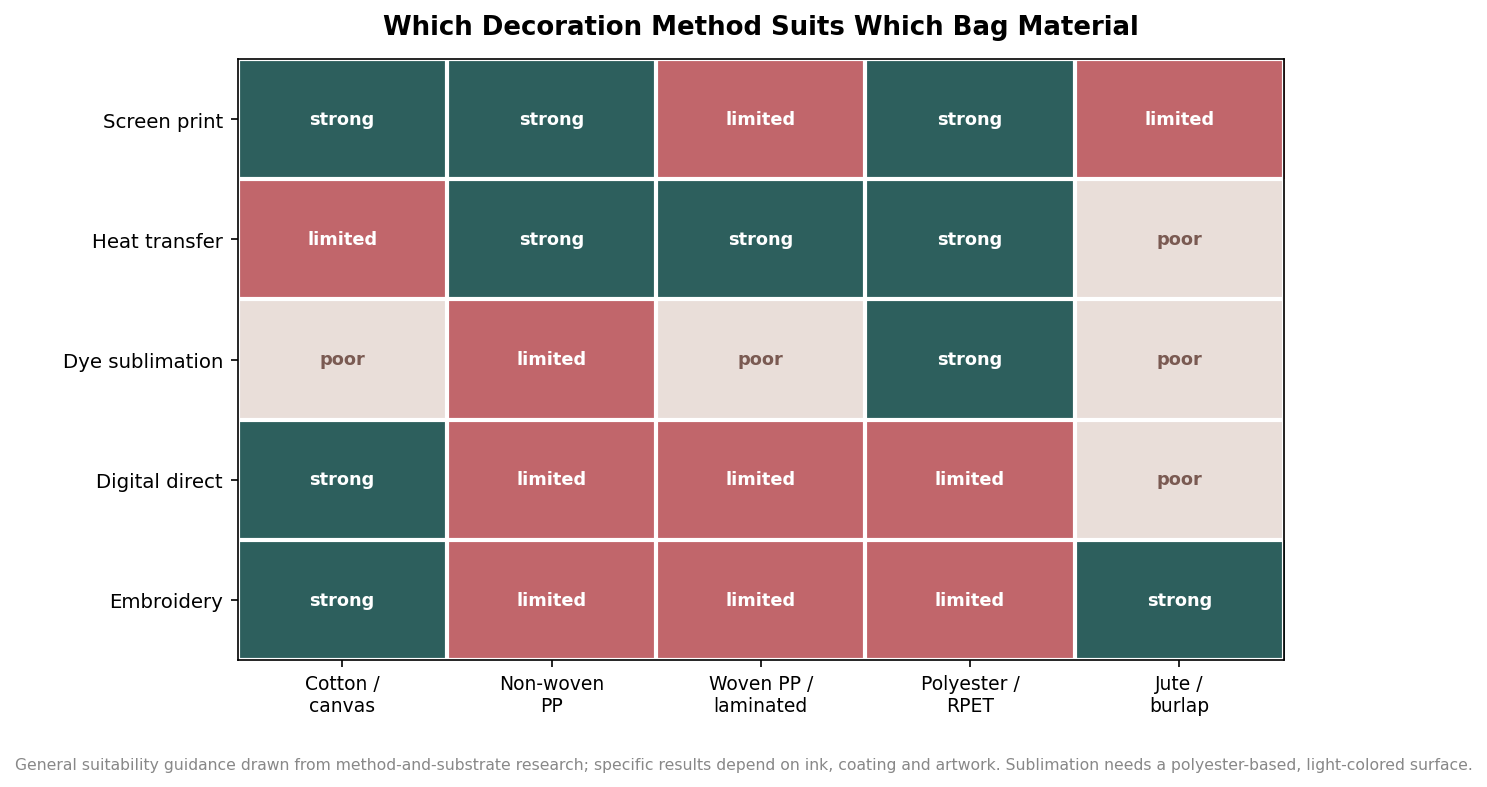
Read together, the two charts give you a clean decision path. Start with quantity and color. A one or two color logo in the hundreds or thousands is a screen-printing job almost every time. A colorful design in a run of a few dozen to a couple hundred is where heat transfer earns its place. Then check the fabric. If the design has to run edge to edge, you are choosing a polyester or RPET bag and sublimation to match. If the bag is a heavyweight cotton or jute piece meant to feel premium, embroidery justifies its cost.
One specification protects you regardless of method: ask for a physical, decorated pre-production sample before the full run, and where washing matters, put it through a few cycles yourself. Approval proofs show color and placement but not how the print ages, and the difference between methods only becomes obvious after real use. The figures and cost curves here are indicative planning guides rather than exact quotes, but the underlying trade-offs, setup versus per-piece cost, surface layer versus in-fiber bonding, hold across suppliers, and getting the method right the first time is what keeps a reorder from becoming a redo.
Create your custom reusable bags now.
Send your logo, quantity and date — you’ll get a free mockup and quote within one business day.
Get a QuoteWin Free Stuff
Enter below for a chance to win plus receive 10% off your first order.
🎉 You are in!
Check your email for your 10% off code. Good luck!