What Size Reusable Bag Do You Actually Need? A Spec-by-Use Guide
Buying a reusable bag looks like one decision and is really three: the dimensions, the depth of the gusset, and how the bag is built to carry weight. Match all three to the job and the bag does its work for years. Get them wrong in either direction and you pay for it, either by ordering a heavy grocery tote just to hand out a single flyer, or by giving a customer a flimsy shopper that splits the first time it holds a six-pack. Here is how to size and spec a bag around what it will actually carry, rather than around whatever stock listing happened to be cheapest.
Start from the contents, then choose the dimensions
Every sizing decision should begin with the largest and heaviest thing the bag needs to hold, because that one item sets the floor for both dimensions and construction. A boutique or retail shopper for apparel and small goods is typically around 8 by 10 inches with a shallow 4-inch gusset, enough for a folded garment and a receipt. A general everyday tote runs closer to 12 by 15 inches, and a proper grocery tote grows to roughly 14 to 16 inches wide and 15 to 20 inches tall with a deep gusset so it can stand open on a counter while it is packed. The chart below lays out common figures for each use. Treat them as starting points, because the moment your product is unusually tall, wide, or heavy, the stock size stops being the right answer.
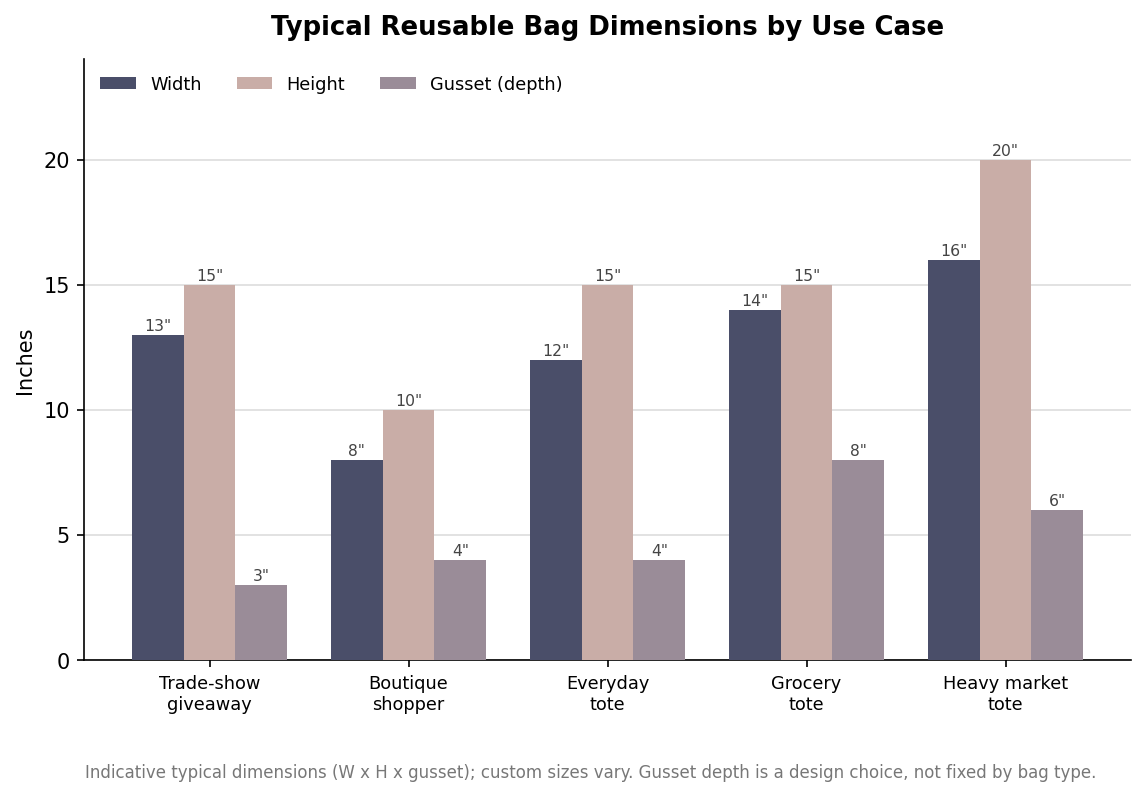
Capacity climbs quickly with size. A small shopper comfortably carries a few pounds, a standard shopping bag more like nine to thirteen, and a large grocery tote somewhere in the range of twenty to twenty-five pounds when it is genuinely built for it. Those numbers all assume the construction matches the size, which is the part buyers most often skip past.
The gusset is the spec people forget
The gusset, the panel that gives a bag its depth, is what separates a flat sleeve from a bag that stands up and holds volume. A 4-inch gusset is fine for clothing and flat goods, but an 8-inch gusset is what lets a grocery tote hold boxes, deli containers, or bottles upright without tipping over. It matters for print, too. A deep, boxy bag presents a flat front panel that shows a logo cleanly, while a shallow flat bag creases straight across the artwork every time it is filled. It also affects folding: a bag with a deep gusset and a structured bottom folds down less compactly than a plain flat tote, a trade-off worth weighing if the bag is meant to live in a pocket or glovebox between trips. Decide the gusset on purpose rather than accepting whatever the base size ships with, because it changes how the bag functions, how it stores, and how your branding reads in a customer’s hand.
Weight is carried by construction, not fabric weight alone
It is tempting to treat the fabric’s GSM, its grams per square meter, as the whole durability story. It is not. A heavier fabric does resist stretching and tearing, but the load a bag can actually carry is decided at the handles, the seams, and the bottom. Handles stitched across a wide anchor point and bar-tacked at the join hold far more than handles merely heat-welded to a light face. A reinforced or board-insert bottom keeps a full bag from sagging and stressing its seams, and the side seams themselves matter as much as the handles: a double-stitched or folded-and-sewn seam resists splitting under a heavy, shifting load far better than a single row of stitches, so it is worth asking which a supplier uses before you compare their prices. And the handle drop should match how the bag is carried: a drop of roughly 9 to 10 inches suits hand carrying, while a shoulder-carry bag needs closer to 12 inches or more so it clears a coat. Spec the construction to the weight first, then choose a fabric weight to suit the number of uses you expect.
Match the fabric weight to how long it must last
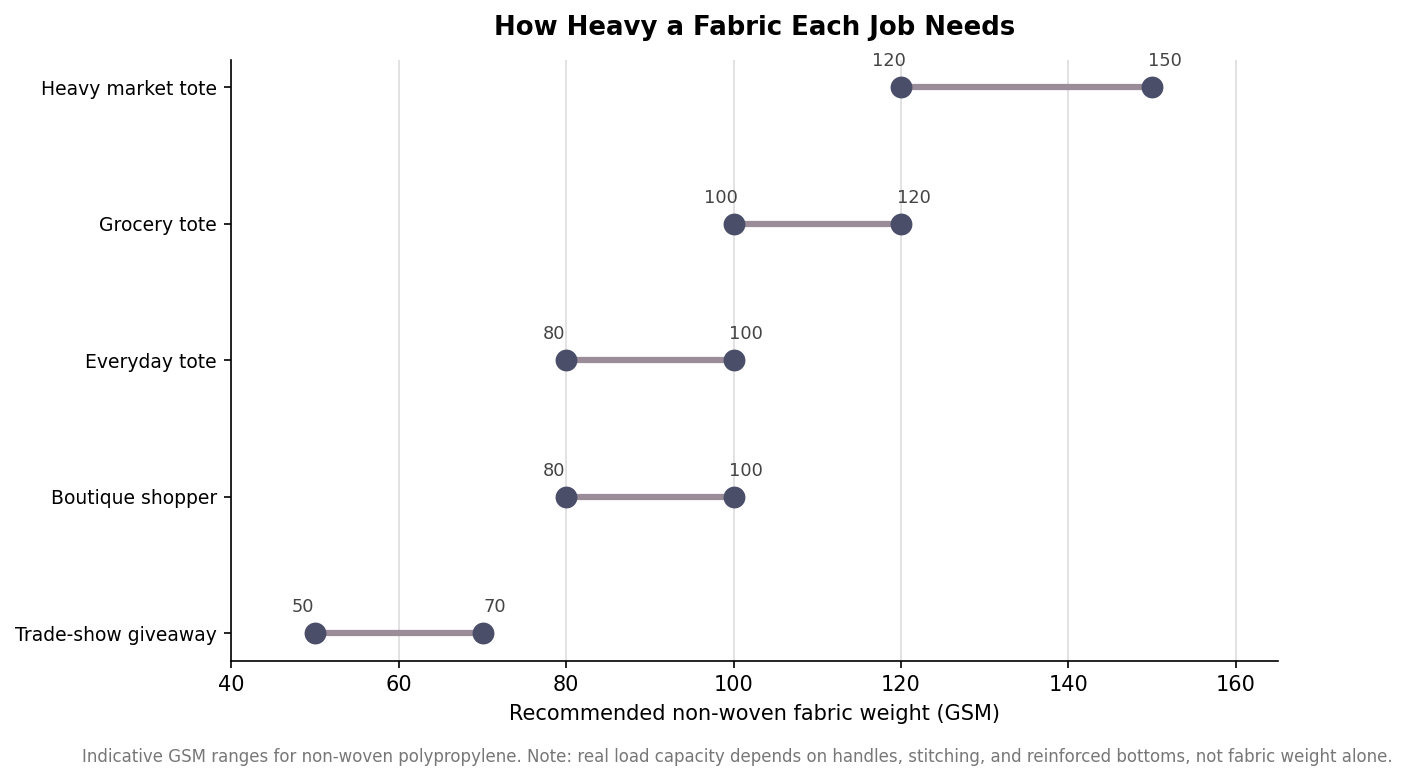
With construction settled, GSM sets the tier of durability and cost. As a rough guide for non-woven polypropylene, 50 to 70 GSM is giveaway-grade, right for a trade-show handout with one season of life in it. 80 to 100 GSM is the everyday shopper most retailers hand out. 100 to 120 GSM is the standard for a reusable grocery bag expected to survive weekly loads, and 120 GSM and up is heavy-duty territory for market totes and wet or bulky goods. The chart below shows those bands. When a bag needs to shrug off rain or carry a full-bleed photographic print, a laminated non-woven or a woven polypropylene steps up again, and cotton canvas in the 10-to-12-ounce range is the premium, long-life option where a natural look matters most. For wine and bottles, add rigid dividers rather than trusting fabric alone to keep them upright.
Put the spec together before you price it
The order that keeps you out of trouble is contents first, then dimensions and gusset, then construction, then fabric weight, and only then print method and quantity. A bag specified in that sequence gets priced honestly, because the quote reflects a build that will actually survive its job. A bag specified backward, chosen off a price-per-piece line and sized afterward, is the one that comes back as a complaint two weeks later. Reusable bags earn their keep by being carried in public for years, so a few extra minutes matching the spec to the load is the cheapest quality control you will ever run.
Create your custom reusable bags now.
Send your logo, quantity and date — you’ll get a free mockup and quote within one business day.
Get a QuoteWin Free Stuff
Enter below for a chance to win plus receive 10% off your first order.
🎉 You are in!
Check your email for your 10% off code. Good luck!